

The BigBear.ai Buzz: A Deep Dive into the 15% Jump and the Whisper of Caution
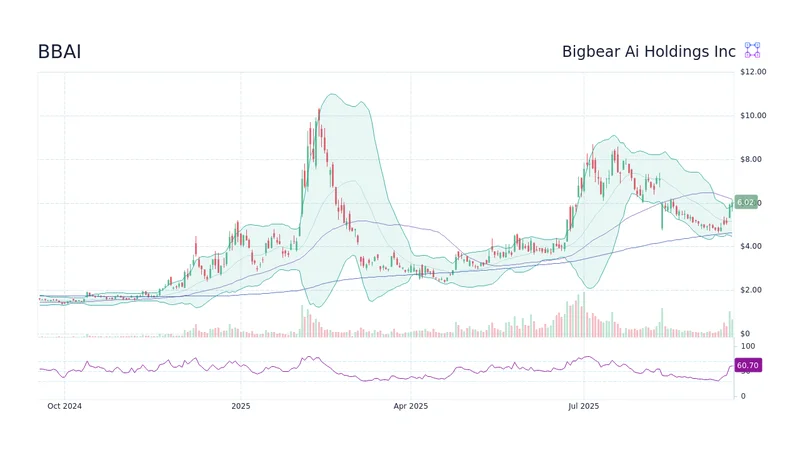
The market, bless its excitable heart, saw BigBear.ai (BBAI) shares surge a solid 15% in post-market trading this past Monday. The catalyst? A seemingly potent one-two punch: better-than-expected third-quarter financial results and the strategic announcement of acquiring Ask Sage. On the surface, it’s the kind of news that sends a jolt of adrenaline through the trading floor, a collective cheer echoing through the digital ether as numbers flash green. But for those of us who prefer to look beyond the immediate euphoria and into the actual balance sheets, the narrative gets a little more nuanced.
Ask Sage, for the uninitiated, is touted as a generative AI platform designed for secure distribution of artificial intelligence. In today's climate, anything with "generative AI" and "security" attached to it is practically a golden ticket. It's a smart play, no doubt, especially for a company like BigBear.ai that's already deeply embedded in the U.S. security sector. Their existing partnerships, like the collaboration with the Joint Chiefs of Staff on force management or the domain awareness project with the U.S. Navy, paint a picture of a company with its claws firmly in the lucrative government pie. Projects like face recognition at U.S. airports and cargo screening at the Panama Canal aren’t exactly small potatoes either. This is the kind of operational footprint that makes investors sit up and take notice, particularly with the U.S. FY 2026 defense budget proposing a staggering $13.4 billion for autonomy and autonomous systems. You can practically hear the cash registers ringing.
The Market's Sugar Rush vs. Sustained Energy
But here’s the thing about market jumps: they can often feel like a sugar rush. Immediate, exhilarating, but sometimes lacking the nutritional value for sustained energy. Before this latest pop, BBAI's stock had been on a bit of a rollercoaster. It more than doubled since hitting a mid-April trough, only to start sliding back to earth in the weeks leading up to this Q3 report. Why the pullback? Concerns over valuation, persistent losses, and, perhaps most critically, reduced 2025 revenue guidance. Add in the ongoing government shutdown, which always throws a wrench into the timing of new contract awards, and you had a recipe for investor apprehension.
This is precisely where the perspective of analysts like "Juxtaposed Ideas"—a 5-star investor among the top 2% tracked by TipRanks—becomes invaluable. Prior to the Q3 report, Juxtaposed Ideas wasn't exactly bearish, noting a growing backlog of $380 million (which, to be more exact, grew 43% year-on-year in Q2). That’s not insignificant. However, their assessment was clear: the overall AI exuberance had pushed BBAI’s stock too high, creating a "minimal margin of safety" at current levels. They cautioned against 'loading up,' preferring to maintain a 'Hold' rating until further clarity emerged from the very Q3 earnings call that just sent shares skyrocketing.
So, the question naturally arises: did the Q3 report and the Ask Sage acquisition truly address the underlying concerns about valuation, continued losses, and reduced 2025 revenue guidance? Or was this 15% jump primarily a reaction to the headline news, a classic case of market participants buying the rumor (or at least the initial good news) before fully digesting the implications? I’ve looked at hundreds of these filings, and the immediate, sometimes disproportionate, reaction to an acquisition announcement, especially in a hot sector like AI, can often overshadow the cold, hard numbers that dictate long-term value. What exactly was the acquisition cost for Ask Sage, and how does that impact BigBear.ai’s immediate liquidity or future profitability projections? The details on that remain scarce, but the market's enthusiasm is clear.
What the Numbers Are Still Whispering
While the market's enthusiasm is palpable, and the prospect of a generative AI platform for secure distribution is certainly appealing, we need to ask ourselves if the fundamentals have shifted enough to justify the rapid ascent. The average 12-month price target from the three analysts tracked by TipRanks, even with two "Buy" ratings, suggested just under 3% upside before this jump. Does a 15% post-market surge suddenly make that target obsolete, or does it push the stock even further beyond what a conservative, data-driven analysis would suggest?
This is where, frankly, I start to raise an eyebrow. The market can be like a crowd at a concert: a sudden burst of applause for a catchy riff, even if the band hasn't quite hit its stride on the whole album. The integration of Ask Sage could be transformative, absolutely. But acquisitions are complex beasts. They require seamless integration, cultural alignment, and a clear path to revenue synergy—elements that take time, not just a single earnings call, to materialize. Are we seeing a genuine re-rating based on deeply improved financial outlooks, or is this more of a speculative bet on the AI narrative, amplified by a government budget that’s still in the proposal stage for FY2026? It’s a critical distinction.
The Elephant in the Room: Valuation Discrepancy
The market’s immediate reaction to BigBear.ai's Q3 results and the Ask Sage acquisition feels a bit like building a skyscraper on a foundation that an experienced engineer (like Juxtaposed Ideas) just flagged as having a "minimal margin of safety." The enthusiasm for AI is undeniable, and BigBear.ai's government contracts are solid, but the underlying concerns about valuation and guidance haven't magically vanished. This 15% jump might be a victory lap for now, but I'd be watching the subsequent trading days very closely to see if the market's initial rush can translate into sustained, fundamental growth.