

FAA Restrictions: A Calculated Risk?
The FAA's decision to restrict commercial space launches to nighttime hours, starting November 10, 2025, is a direct consequence of the government shutdown and its impact on air traffic control. Controllers are not being paid, leading to increased absenteeism and, presumably, a higher margin for error. The FAA's order includes a temporary 10 percent reduction in flights at 40 high-traffic airports, Orlando and Los Angeles included. It's a blunt instrument (a temporary cut), but the logic is simple: fewer flights, fewer risks.
SpaceX, predictably, is pushing ahead. They launched a batch of Starlink satellites on November 9th at 3:10 a.m. EST. This was the 28th flight for Falcon 9 booster B1069, a workhorse if there ever was one. The booster landed on the drone ship ‘A Shortfall of Gravitas.’ The mission deployed 29 Starlink V2 Mini Optimized satellites. Another launch is scheduled for the evening of November 10th. Five more Starlink missions are planned between November 10th and 19th, plus the Transporter-15 mission on November 11th.
This flurry of activity raises a key question: How much is the FAA willing to bend? The order states the agency has the flexibility to modify or remove provisions at the request of an operator. SpaceX clearly intends to keep launching. Will the FAA grant waivers, effectively negating the restrictions? Or will they hold firm, potentially delaying SpaceX's ambitious launch schedule? (And what's the FAA's actual threshold for "stress" on the system? It's not defined in the announcement.)
A Balancing Act
Rocket Lab says that launches from Launch Complex 1 in New Zealand are unaffected, and they expect minimal impact to launches from LC-2 in Virginia. This highlights a crucial point: the restrictions are localized. New Zealand's space ambitions remain unfettered by Washington gridlock.
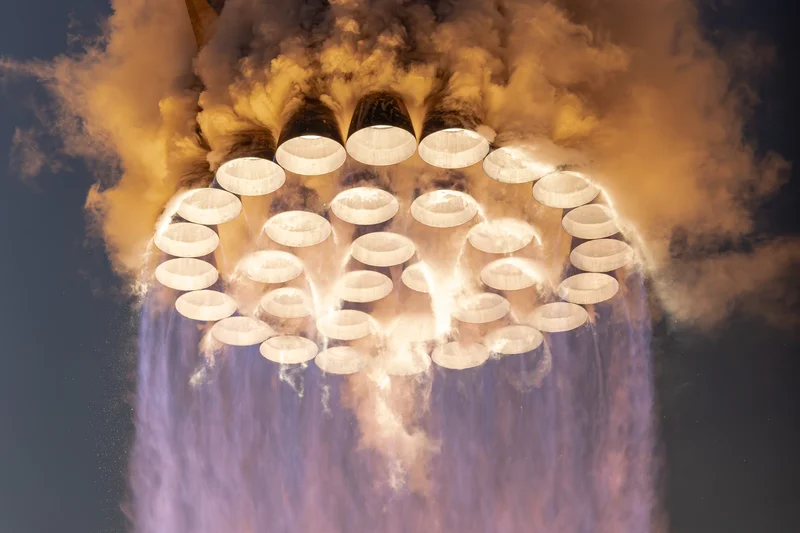
We also see the human element in this data. Steve Dunn reported seeing re-entering space debris and hearing sonic booms, while Steve Bachman's son captured a video of the re-entry. These aren’t just abstract events; they’re visible, audible experiences for people on the ground. It's easy to get lost in launch schedules and booster statistics, but these anecdotal reports remind us of the tangible reality of spaceflight. The FAA’s decision isn’t just about numbers; it’s about public perception and safety, even if the actual risk is statistically low.
SpaceX scrubbed a launch on November 8th due to poor booster recovery weather, and ULA's Atlas 5 launch was scrubbed twice due to valve problems. These delays are normal. The 45th Weather Squadron forecast a 95 percent chance for favorable weather for the Nov. 9th launch—or, to be more precise, a 95% chance with a small chance for interference from cumulus clouds. Even with advanced forecasting, there's always an element of uncertainty. I've looked at hundreds of these weather forecasts, and the degree of precision is, frankly, impressive. But 5% is still 5%.
The Real Flight Risk
The FAA's restrictions are a temporary measure, expected to be rolled back once funding is restored. But this episode reveals a vulnerability: The space industry's reliance on government infrastructure makes it susceptible to political dysfunction. The FAA needs to balance safety and operational efficiency with the needs of a rapidly growing commercial space sector. The question isn't just about launch times; it's about the long-term resilience of the industry. And, frankly, I'm not sure the current system is designed for that kind of flexibility.