

SoundHound's AI Hype Train: Revenue Up, But Is the Track Sound?
SoundHound AI (SOUN) is riding high on the AI wave, with its stock price reflecting the optimism. A 70% surge in the past six months is nothing to sneeze at. But is this rally justified, or are investors getting ahead of the fundamentals? Let’s dig into the numbers and see if SoundHound is truly poised for long-term growth, or just another flash in the AI pan.
The core narrative is compelling: SoundHound's voice recognition and natural language processing capabilities are seeing increased demand. Analysts are projecting a revenue jump of over 60% year-over-year for Q3, reaching $40.5 million. Wainwright's Scott Buck even raised his price target to a Street-high of $26, suggesting a potential upside of over 65% from current levels. The bull case rests on the idea that SoundHound's data advantage – processing over 1 billion voice queries monthly – gives it a competitive edge. They claim their Polaris AI model is outperforming competitors in voice recognition accuracy.
But here’s where my skepticism kicks in. That claim of outperforming competitors needs serious scrutiny. What metrics are they using? What's the margin of difference? And more importantly, how sustainable is this lead? The advantage of data is only as good as your ability to turn it into a competitive advantage, and I'm not seeing enough concrete evidence that SoundHound is doing that effectively.
The GAAP Reality Check
The recent Q3 results paint a more nuanced picture. Revenue did jump 68% to $42 million. But the stock plunged 9.5% despite this growth. Why the disconnect? The devil, as always, is in the details. SoundHound AI (SOUN) Stock: Plunges 9.5% Despite Strong Q3 Revenue Surge and Expanding AI Footprint reported a GAAP net loss of $109.3 million, a massive increase from the $21.8 million loss in the same quarter last year. A significant chunk of this – $66 million, to be exact – is attributed to non-cash acquisition-related liabilities.
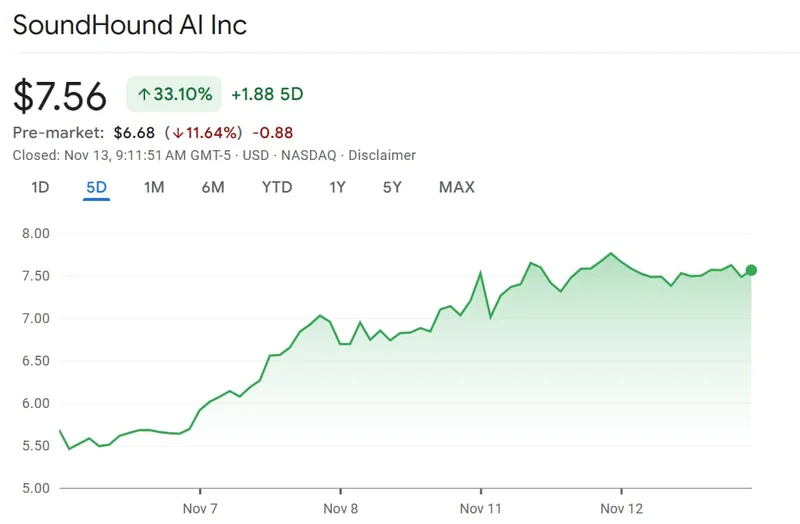
Okay, so it's a non-cash charge. But that doesn't mean it's irrelevant. These liabilities are tied to the company's rising stock price, meaning that as the stock goes up, so does the expense. It's a bizarre situation where success actually hurts the bottom line (at least on a GAAP basis). And this is the part of the report that I find genuinely puzzling. Why structure an acquisition deal in this way? It creates a perverse incentive, where the company is penalized for its own success.
Analysts are still maintaining a "Moderate Buy" consensus, with an average price target of $16.67. But that target only suggests a 6% upside from current levels. Hardly the kind of explosive growth that the AI hype would have you believe.
Momentum vs. Fundamentals
Benzinga's Edge Rankings give SoundHound a very high Momentum score of 95.20. But their short-term price trend is rated as negative. This highlights the key tension: SoundHound has momentum, but its underlying fundamentals are still shaky. They are burning cash, and relying on a narrative of future growth to justify their current valuation. That’s a dangerous game, especially in a volatile market.
I've looked at hundreds of these filings. And this particular situation reminds me of a tech company during the dot-com bubble – lots of hype, impressive revenue growth, but a questionable path to profitability. SoundHound needs to demonstrate that it can translate its data advantage into real, sustainable earnings. Otherwise, this rally will eventually run out of steam.
A Hype Train Running on Fumes?
SoundHound is benefiting from the AI gold rush, and its revenue growth is undeniable. But investors need to look beyond the headlines and examine the underlying financials. The GAAP losses, the unusual acquisition-related liabilities, and the reliance on future growth all raise red flags. Until SoundHound can demonstrate a clear path to profitability, this stock remains a high-risk, high-reward bet.